
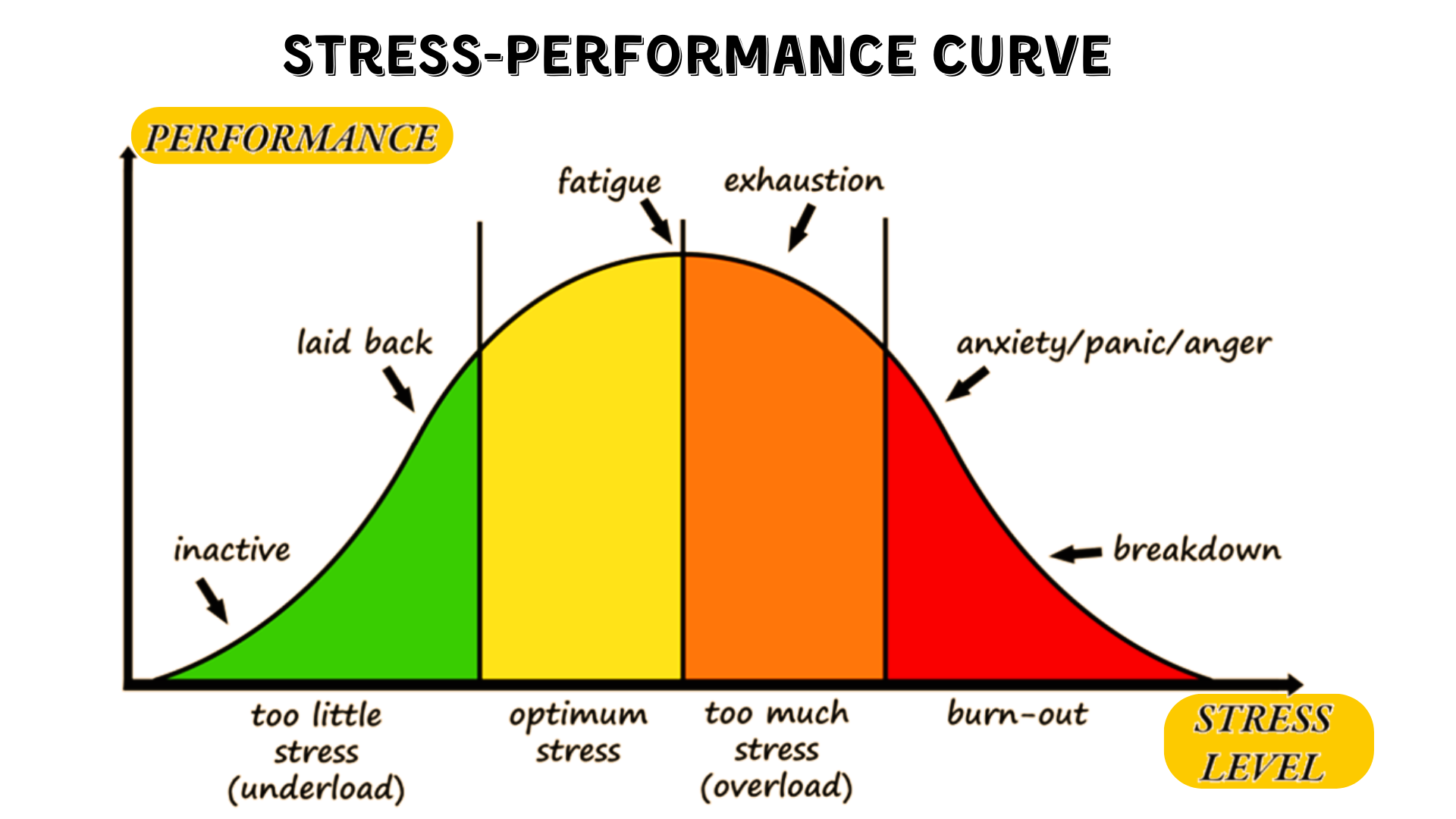
The idea that a little stress can be good for performance, known as the Yerkes-Dodson law, has not been debunked but rather refined by modern research.
It is generally accepted that an optimal level of stress can enhance performance by increasing alertness and motivation.
This however varies greatly among individuals and depends on factors such as task complexity, the type of stress, and coping mechanisms.
Short-term, manageable stress (eustress) can be beneficial, but chronic or severe stress (distress) often impairs performance.
Eustress can motivate and energize, whereas distress can lead to anxiety, fatigue, and decreased performance.
The relationship between stress and performance is not always a simple inverted U-shape and can be more complex based on the context and individual.
Therefore, while a little stress can be good for performance, it's important to consider individual differences, the type of stress, the complexity of the task, and the coping mechanisms when evaluating the impact of stress on performance.
Why is Prolonged Stress Bad for You ?
Chronic Stress and Cognition: Studies show that long-term stress can make it harder to think clearly, remember things, and solve problems quickly. This fits with the idea that too much stress can make it hard to do things well, which is something called the Yerkes-Dodson law.
Brain Structure: Long-term stress can shrink important parts of the brain that help us think and remember. This means that too much stress can change the brain in ways that make it harder to think clearly and remember things.
Non-Linear Relationship: A little stress doesn't hurt thinking skills. However, too much stress or stress that lasts a long time can make it harder to think clearly. This means that how stress affects us isn't simple; it depends on how much stress there is and how I personally react to it.
New Research on Stress
New research suggests that stress should be seen as an external force applied to a person. It can come from things outside of us, like work, life events, or things in our environment. But stress isn't just about what happens outside; it's also about how we react inside.
How we Think About Stress:
We can choose how we react to things around us. This is called cognitive appraisal. A scientist named Richard Lazarus said that we look at what's stressing us and decide if we can handle it. First, we think about if the stress is important or not. Then, we think about if we can cope with it.
Perceived Stress:
After we think about the stress, we feel it in our own way. This is called perceived stress. Two people might have the same thing happen to them, but they might feel it differently. Something that stresses one person might not stress another.
When Stress is Bad:
If we think something is stressful and we can't handle it, we might feel bad. This is called strain. Strain can make us feel sick, tired, worried, or irritated. It can also make us do things differently, like not doing our best or staying away from things.
When Stress is Good:
If we think we can handle the stress and see it as a chance to do something good, it can help us. This is called eustress. It can make us do better, feel more motivated, and grow as a person.
How we Deal with Stress:
How we deal with stress, called coping, also changes how stress affects us. Coping can be trying to fix the problem or handling our feelings about it. Good coping can help us so that stress doesn't make us perform worse.
Stress vs Strain
The relationship between stress and strain can be summarized as follows:
𝗦𝘁𝗿𝗲𝘀𝘀 refers to external demands, forces, or pressures placed on an individual. These can include work demands, life events, or environmental factors.
𝗦𝘁𝗿𝗮𝗶𝗻 refers to the individual's internal response or reaction to these external stressors. Strain can manifest in various ways, including physical symptoms (e.g., headaches, fatigue), emotional responses (e.g., anxiety, irritability), and behavioural changes (e.g., decreased performance, increased absenteeism).
The relationship between stress and strain is 𝗺𝗲𝗱𝗶𝗮𝘁𝗲𝗱 by the individual's appraisal of the stressor, their coping mechanisms and how much they feel they are able to cope with the issue at hand.
Chronic or severe stress, especially when accompanied by ineffective coping, can lead to prolonged or excessive strain, which can have detrimental effects on an individual's health, well-being, and performance.
In summary, stress and strain are related but distinct concepts.
- Stress refers to external demands, while strain refers to the individual's internal response to those demands.
- The relationship between the two is influenced by how we think about stress (cognitive appraisal) and coping mechanisms, and it is not always linear or straightforward.
- Effective stress management involves addressing both the external stressors and the individual's internal response to them.
➡️ If you feel you have the resources and knowledge to effectively cope with the cause of stress, you are able to perform under that stress. The issue you have to deal with becomes ‘manageable’ for you.
👉 Ensure you have adequate resources allocated to your project.
👉 Build your project management knowledge of best practice through reading, training and certification.
👉 Make sure you have access to support, like a coach, to help you deal with challenges that come your way.
Sources:
Yerkes, R. M., & Dodson, J. D. (1908). The relation of strength of stimulus to rapidity of habit-formation. Journal of Comparative Neurology and Psychology, 18, 459-482.
Teigen, K. H. (1994). Yerkes-Dodson: A law for all seasons. Theory & Psychology, 4(4), 525-547.
Keller, M., & Just, M. A. (2012). Chronic stress, cognition, and neuroplasticity in middle-aged and older adults: Evidence from the Wisconsin Registry for Alzheimer's Prevention. Neurobiology of Aging, 33(9), 2066-2077.
Lazarus, R. S. (1993). Coping theory and research: Past, present, and future. Psychosomatic Medicine, 55(3), 234-247.
Folkman, S., & Lazarus, R. S. (1985). If it changes it must be a process: Study of emotion and coping during three stages of a college examination. Journal of Personality and Social Psychology, 48(1), 150-170.
Selye, H. (1974). Stress without distress. Philadelphia: J. B. Lippincott.
Quick, J. C., & Quick, J. D. (1984). Occupational stress and strain: Toward a conceptual integration. Basic and Applied Social Psychology, 5(3), 211-229.